How to Tell if a Business Class Cabin Is New or Outdated
Want to know how to spot if a business class cabin is new or old? Hint: it’s not always the price
Buying business class tickets should be easy. You pay more money, you get treated better.
Unfortunately, airlines don’t make this process straightforward. While two tickets might be listed at similar prices, they can lead to wildly different products.
Want an older seat with a mattress? You can get that. Fancy a fully flat bed with a sliding privacy door? You can get that too.
Learning how to quickly spot if a cabin is new or old is one of the most valuable skills you can learn when booking business class travel. It lets you avoid over-paying for outdated cabins and identify undervalued flights where newer products are still available.
So let’s dig into everything you need to know.
The Seat Type Will Tell You Almost Everything (Start Here)
The easiest way to spot a newer cabin vs older cabin is by checking the seat type.
Longhaul business class these days revolves around fully flat beds. Older cabins are more likely to use angled or simply reclining seats.
-
Fully flat beds mean modern standard product
-
Angled flat beds mean older generation seats
-
Recliner seats are trash, don’t book
Fully flat seats allow you to sleep completely horizontal. This has become the standard these days on longhaul flights.
Angled flat beds don’t lie completely flat when you pull them all the way back. These seats are a few generations older.
Business class recliner seats used to be fairly common, but thankfully are less so these days. You’ll still see them on short haul routes and older aircraft, but shouldn’t expect to find them onboard modern aircraft configured for longhaul business travel.
Rule of thumb: if it doesn’t turn into a bed, it isn’t modern business class.
The Seat Layout Is Another Dead Giveaway (Privacy = Newer)
Want another easy tip to spot old vs new cabins? Check out how the seats are arranged.
Modern layouts feature:
-
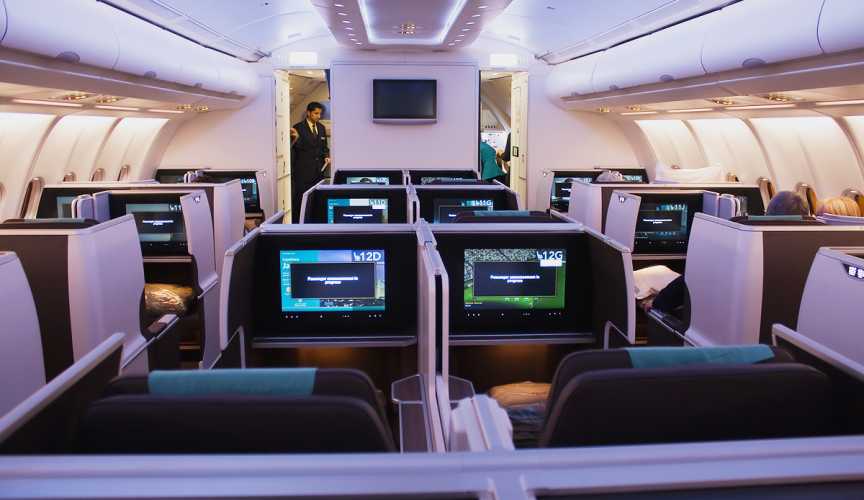
1-2-1 configuration
-
Direct aisle access for every passenger
-
Privacy panels or doors separating every seat
Older layouts usually feature:
-
2-2-2, or sometimes 2-3-2 configuration
-
Some passengers must climb over their neighbors to reach the aisle
-
Little to no privacy
Business class seats these days are being designed around giving every passenger direct aisle access. Newer products have a 1-2-1 configuration where each seat has its own direct route to the aisle.
Older cabins often put passengers side-by-side, where you might need to climb over your neighbor to get up and use the bathroom.
Want proof airlines are trying to eliminate older seat configurations? Check out how many airlines are phasing out 2-3-2 business class layouts since middle seats are no longer acceptable in premium cabins.
Rule of thumb: if you don’t have direct aisle access to your seat, chances are you’re in an older generation cabin.
Cabins With Doors/Suites Are Always Newer
One of the biggest evolutions in recent years has been the transition to suite-style seating.
If you see:
-
Sliding privacy doors
-
Tall seat walls creating separation
-
Rooms instead of seats
Chances are you’re booking a newer cabin.
Airline seat designers have started building modern business class around private suites. Many of these rooms feature doors that fully seal off each bed from the rest of the cabin.
Cabins Without HD Screens Are Older
Another huge tip-off when it comes to new vs old cabins? Technology.
Newer cabins will typically feature:
-
Large 4K / HD screens
-
Bluetooth headphone pairing
-
USB-C power ports
-
Wireless charging
-
Touchscreen controls
Older cabins tend to feature smaller screens, hardwired headsets, and more limited technology options. Screens are honestly one of the easiest ways to tell older cabins from newer cabins.
Tiny details reveal everything about the cabin
Not convinced yet? Here’s a few more subtle tips to look for when trying to figure out if a cabin is old or new.
Does your phone have a place to sit? Modern cabins. Old cabin, not so much.
Can you eat off the table without it rocking back and forth? Modern cabin.
Modern cabins take into account little things you didn’t know you cared about. Until you fly in an older cabin.
Lighting Is Everywhere Now, Dark Cabins Are Old
This is subtle, but new cabins tend to focus on ambiance now.
Newer cabins will usually have:
-
Different lighting options for when you want to sleep vs eat
-
Much cleaner cabin design
-
Better use of space and materials
Airlines are starting to invest more in mood lighting to help boost relaxation and reduce stress during your flight.
Older cabins tend to be darker and just feel “old.”
Check the Plane, Not Just the Airline Name
Want to know a secret most people don’t realize about business class?
Booking “business class” from airline X doesn’t always guarantee you the same cabin.
Many airlines operate older versions of business class on the same route alongside their newer products. Airlines like Air Canada, Emirates, All Nippon Airways, and Delta are just a few that currently offer more than one version of business class on certain flights.
That means you can book:
-
The exact same route
-
With the exact same airline
-
For the exact same price
…but fly on completely different products.
Rule of thumb: Never book a flight without first checking the plane.
Spot Newer Cabin Layouts By Reading the Seat Map
Truth is, you don’t need to know all of the above.
Just look at the seat map when booking flights. You’ll instantly know if you’re getting a newer cabin just by glancing at how seats are positioned.
Tell-tale signs of a newer cabin:
-
Seats aren’t positioned in straight rows
-
Seats are staggered rather than directly across from one another
-
Every seat has direct aisle access
Older cabins will often feature older seat layouts that haven’t been upgraded to the staggered style.
Business Class is Different on Short-Haul Flights
Before you go crazy analyzing cabin features, know this: short haul business class is not always the same as long haul business class.
Many airlines in Europe and around the world use business class as a way to simply offer extra legroom on seats that are otherwise exactly the same.
This isn’t necessarily bad, and is actually to be expected when comparing short haul vs long haul business class.
Bottom line: longhaul flights should have beds. Short haul flights should not.
Why Spotting Old Vs New Cabins Matter When You’re Trying to Save
Why should you care about old vs new cabins?
If you know what you’re looking at, you can:
-
Stop overpaying for outdated seats
-
Identify underrated flights where newer cabins are priced wrong
-
Book better routes (longer flights with newer cabins can be much better than shorter outdated ones)
The internet is full of resources telling you how to save money on business class. Unfortunately, most of them don’t cover this aspect.
BCFlights makes sure you always know what you’re getting before you book.
We don’t just show you prices for business class flights. You’ll see exactly what cabin you’ll be flying in too. That way, you’re not just paying for business class. You can pay for the right kind of business class.
Don’t settle for old cabin configurations when there are better priced options available.
TLDR;
Want to spot old business class cabins? Here’s everything you need to know.
Remember:
-
Newer cabins have fully flat beds
-
Newer cabins give you direct aisle access
-
Older cabins will have straight rows of seats
-
Cabins will usually have either 1-2-1 or 2-3-2 seat configurations
-
Look for privacy doors and walls
Do all of the above and you’ll start recognizing old cabins from new ones in no time.
If you want BCFlights to do the work for you, check out our flight search that highlights routes with modern business class cabins.